Last-minute departure · DEC 2026
Open Road
Australia · New Zealand
August 27, 2026
Peter is 70, well-travelled, and not remotely done yet. These are his Notes — small observations from the road.
“One word,” said I. “Have you been time traveling?” “Yes,” said the Time Traveler, with his mouth full, nodding his head.”
― H.G. Wells, The Time Machine
This could have been a conversation had with any Decades Pioneer; we are known for our love of food and, of course, of travel.
An overnight sleeper train is, for me, time travel. I fall asleep over a book in one place and wake somewhere entirely different. But while it is light, to the moment of “can and can’t”, I gaze out the window just to see what there is to see. On our Vietnam adventure Pioneers had two train journeys, both over-night and both across different landscapes.
The first was from Saigon to Hoi An and the second from Hue into Hanoi.
--
The stations, and buying food for the journey.
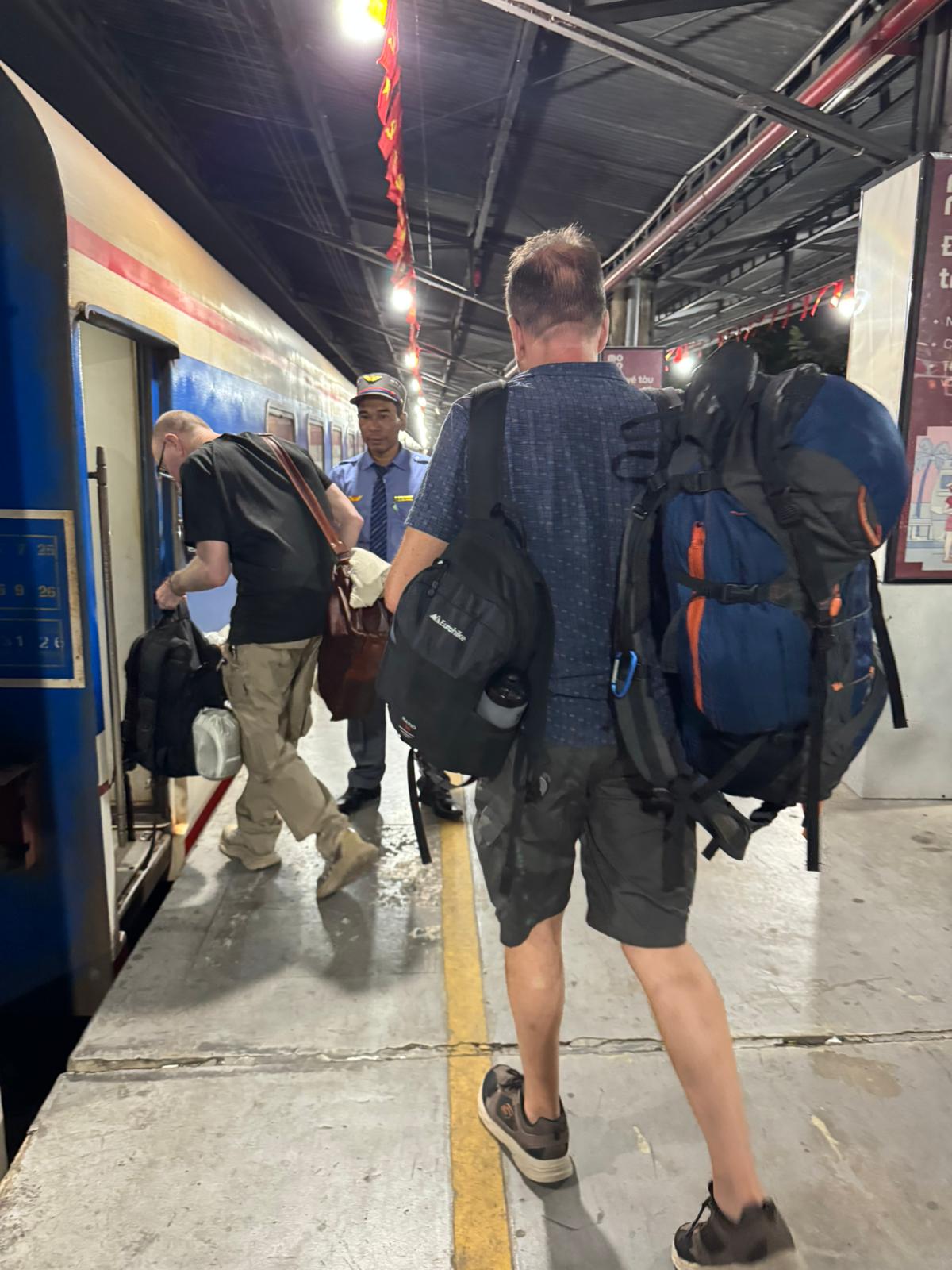
Stations in Vietnam are busy, almost insanely so. Grabs and taxis, small trucks and scooters work their way in and out of the forecourt or park up on pavements as enormous soft bags are manhandled for a family group towards the entrance. Tourists and locals with very little fuss and bother find their train and carriage quite orderly and with good humour while last-minute shopping for snacks at one of the many HiW along the platform. Perhaps it’s better to buy your evening meal or snack Bahn Mi in the station concourse if you want hot food or anything other than snacks in bags. Beverages are no more expensive and the beer cans are larger on the train for the same price but perhaps not so cool. Coffee and tea is served lukewarm but the water dispenser at the end of each carriage dispenses scalding hot water to top up your cardboard cup. Each compartment has a QR code so that one can order, in theory, online from a short menu for delivery to the small table in each compartment. But it is probably better to catch one of the vendors walking along the train.
The carriages have a wash basin at one end in an open area and flush-toilets in the Western style at each end. One is really small so if you are a larger person then best to wait for the other or you may never manage to close the door.
--
The carriage, compartment and sleeping bunks.
On my trains there were two classes of carriage but the more expensive seemed no larger in compartment size or bunks. The main distinguishing features being coloured blankets, pictures on the carriage walls and some corporate decoration in the washroom and toilets. Our bunks had hard foam mattresses and perhaps two smaller pillows and one clean and fresh-smelling blanket. You might wish to ask for another and eventually it will arrive before the extremely effective forced air chills you to the bone as you lie in the upper or lower bunk. Bed lights are present but variable in reliability and luminescence. Above the corridor, accessible only from the compartment, is luggage storage and a plastic bag for waste is hung on some hook or other.
Wi-fi is advertised and even your eSIM may not work. But then connection often does not on Czech Rail or Deutscher Bahn either, or for that matter everywhere on Great Western.
--
What’s to be seen?
From HCMC to Hoi An, the track passes through small urban areas and many kilometres of rice paddies that stretch as far as can be seen. Often a road will parallel the track, sweeping away into the middle distance to be replaced by a canal or chains of wide irrigation ponds. Rice paddies are large and small according to family holdings, deserted or being cropped by scythe or mechanical harvester; or perhaps with egrets preying upon the frogs and small fish hiding among the stalks. Rice paddies do not produce just rice however. As elsewhere in Asia frogs and fish are caught when the paddy is drained for harvest and the ducks that feed in the paddies end as a meal somewhere.
The track passes bare hills of red earth awaiting new plantations of banana trees and the occasional field of maize but the most surprising sight are the many mausoleums, singly or in groups, that appear in the corners of the rice paddies every few miles. Not the grey concrete or carved stone one might find in Europe, but newer ones brightly coloured and with coloured stone or bricks placed around, but many appearing faded, uncared and weed-strewn. On many wider roads many metres of plastic are laden with rice grains drying in the sun while the stalks are mounted around a central vertical pole in every larger backyard.
From Hue, having broken the journey with a spectacular road trip, to Hanoi, rice paddies are fewer with crops of some other type flourishing in the cooler clime. Changed too are the villages alongside the track. These are similar but there are fewer tin roofs, these being replaced by tiles or a flat roof with water tank. Red banners and national flags start to appear on many houses and flutter from fence posts or scooter handle bars. As one comes closer to Hanoi patriotism becomes more obvious as do large yards of construction materials providing the foreground to factories large and small and the hills that appear closer and then recede away from the train as we speed towards the capital.
Drawing into Hanoi the train passes through Train Street. A length of track that you might wish to visit and perhaps brave yourself placing a coin on the track to be flattened by the wheels.
And so, the time travel ends in another bustling and vibrant Vietnamese city. But this time in the capital that is larger, cleaner in many streets, and seemingly more organised. But maintains as everywhere else, fleets of scooters in fluid motion. At least until the government edict to banish anything petrol driven from the city centre is enforced.
.jpeg)
Author

